Improving Uniformity in the Dipping Process: Key Technologies and Industry Trends for Automatic Dipping Machines
In passive component manufacturing, even minor variations in termination can significantly impact downstream processes, leading to defects and inconsistent product performance. Uniformity in the dipping process, the ability to achieve consistent paste coverage on every chip, is critical for conductivity, adhesion, and overall reliability.
From the perspective of LONG Automatic Machinery Co., Ltd, this article explores the main sources of uneven termination, equipment and process-based solutions, and the advantages of automatic loading and unloading dipping machines, single side dipping machines, and double side dipping machines. We also highlight current industry trends such as micro-miniaturization, high-frequency applications, and sustainability, alongside practical applications.
Why Uniformity Matters in the Dipping Process
Achieving consistent dipping uniformity ensures:
- Stable electrical conductivity and adhesion: Thin or incomplete coatings may cause poor conductivity or low solder strength.
- Balanced bandwidth at both ends: Uneven end coverage can lead to tombstoning or soldering defects.
- Even coverage on end faces and corners: Critical for preventing weak spots and enhancing electrical performance.
- Optimal thickness: Termination thickness must be sufficient for conductivity and adhesion but not excessive, avoiding material waste.
Reference image for illustration purposes only.

This image illustrates the first point, "Balanced bandwidth on both ends," with the left side showing uneven bandwidth.

This image illustrates the second point, "Even coverage on end faces and corners," with the left side showing significantly thinner paste at the corners (uneven thickness)
Common Causes of Uneven Dipping
Achieving uniform paste coating requires attention to multiple factors. Variations can arise from the properties of the paste itself, process parameters, environmental conditions, and equipment handling precision. Practical production challenges, such as trapped air bubbles or variations in component size, can further affect uniformity.
The table below summarizes the main causes of uneven dipping, their practical implications, and the corresponding solutions or equipment features commonly used to mitigate these issues:
| Cause Category | Description | Practical Implications | Related Solutions / Equipment Features |
| Paste Characteristics | Viscosity, particle size, sedimentation behavior | Uneven termination thickness, weak coverage on edges or corners | Use stable paste formulations, temperature control, proper tray leveling |
| Dipping Parameters | Dipping height, withdrawal speed, dwell time, shift movement | Variations between batches, risk of over- or under-termination | Precision motion control, adjustable dwell time |
| Environmental Conditions | Temperature, humidity | Changes in paste flow and adhesion; faster drying can cause voids or thin areas | Climate-controlled production area, temperature control of paste |
| Handling Precision & Motion Control | Misalignment, vibration, inconsistent dip head movement | Localized termination inconsistencies; misaligned end faces | Multi-axis adjustment, stable carrier plates, vibration-free mechanisms |
| Practical Production Challenges | Air bubbles/voids, component shape and size variation, single-side vs double-side termination | Electrical integrity issues, additional handling needed for dual-side termination, risk of tombstoning | Vacuum-assisted debubbling, modular single/double-side dipping machines |
Technical Solutions to Improve Uniformity
Precision Motion Control
Servo motors, high-precision linear rails, and PLC/HMI systems regulate diphead movement, speed, and even paste distribution, which is essential for both single-side and double-side dipping machines.
Vacuum-Assisted Debubbling
Vacuum systems remove trapped air in paste and terminations, preventing voids that can affect electrical performance. This feature is integrated into our automatic loading and unloading dipping machines.
Comparing Automatic Loading/Unloading, Single-Side & Double-Side Dipping Machines
| Machine Type | Advantages | Limitations |
| Automatic Loading & Unloading Dipping Machine | Reduces manual errors, increases efficiency, and ensures consistent termination; integrates vacuum debubbling | Higher initial cost; more complex system; recommended for high-volume customers to reduce the need for line changeovers. |
| Single-Side Dipping Machine | Simple structure; lower investment | Additional handling required for dual-side coating |
| Double-Side Dipping Machine | Terminate both sides in one pass, saving time and improving uniformity; ideal for components requiring double-side termination |
Industry Trends
- Miniaturization & High-Frequency Passive Components: 5G, AI servers, and RF modules require precise edge and corner coverage. (Verified Market Reports)
- Sustainability & Energy Efficiency: Reducing waste, optimizing energy usage, and using environmentally friendly materials are key considerations. (Verified Market Reports)
- Customization & Modular Equipment: Modular systems allow rapid switching between single-side, double-side, or different chip sizes, improving production flexibility. (LONG Automatic Machinery)
Industry Applications
- MLCC, resistors, and inductors: Terminal dipping for conductivity and protection.
- Telecom and high-frequency applications: 5G, AI servers, and RF modules.
- Automotive, medical, and wearable devices: Require high reliability under temperature, vibration, and humidity stress.
- Energy storage and battery applications: Double-side termination for lithium battery separators.
Conclusion
Dipping uniformity is a cornerstone of quality, yield, and reliability in passive component manufacturing. Selecting the right machine type (automatic loading and unloading, single side, or double side dipping) and combining precision motion control, vacuum-assisted debubbling, and smart monitoring ensures consistent, high-quality results.
If your company seeks:
- Higher production yield and consistent electrical performance
- Reduced material waste and rework
- Reliable terminaton for high-frequency, small, or double-side components
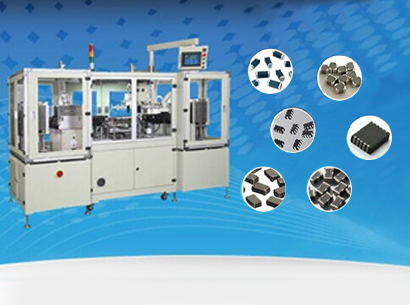
LONG Automatic Machinery’s advanced dipping systems are the ideal solution. Models like LGTM-6837 (Automatic Single Side) and LGTM-6195 (Automatic Double Side) and LGTM-6191-2V (Automatic Loading and Unloading) are designed to meet these needs.

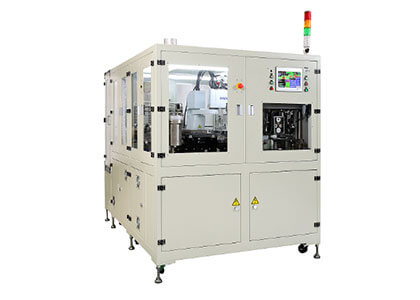
.jpg "LGTM-6191-2V TCP Dipping Equipment Machine")
For inquiries about specifications, implementation, or trials, contact LONG Automatic Machinery Co., Ltd now!